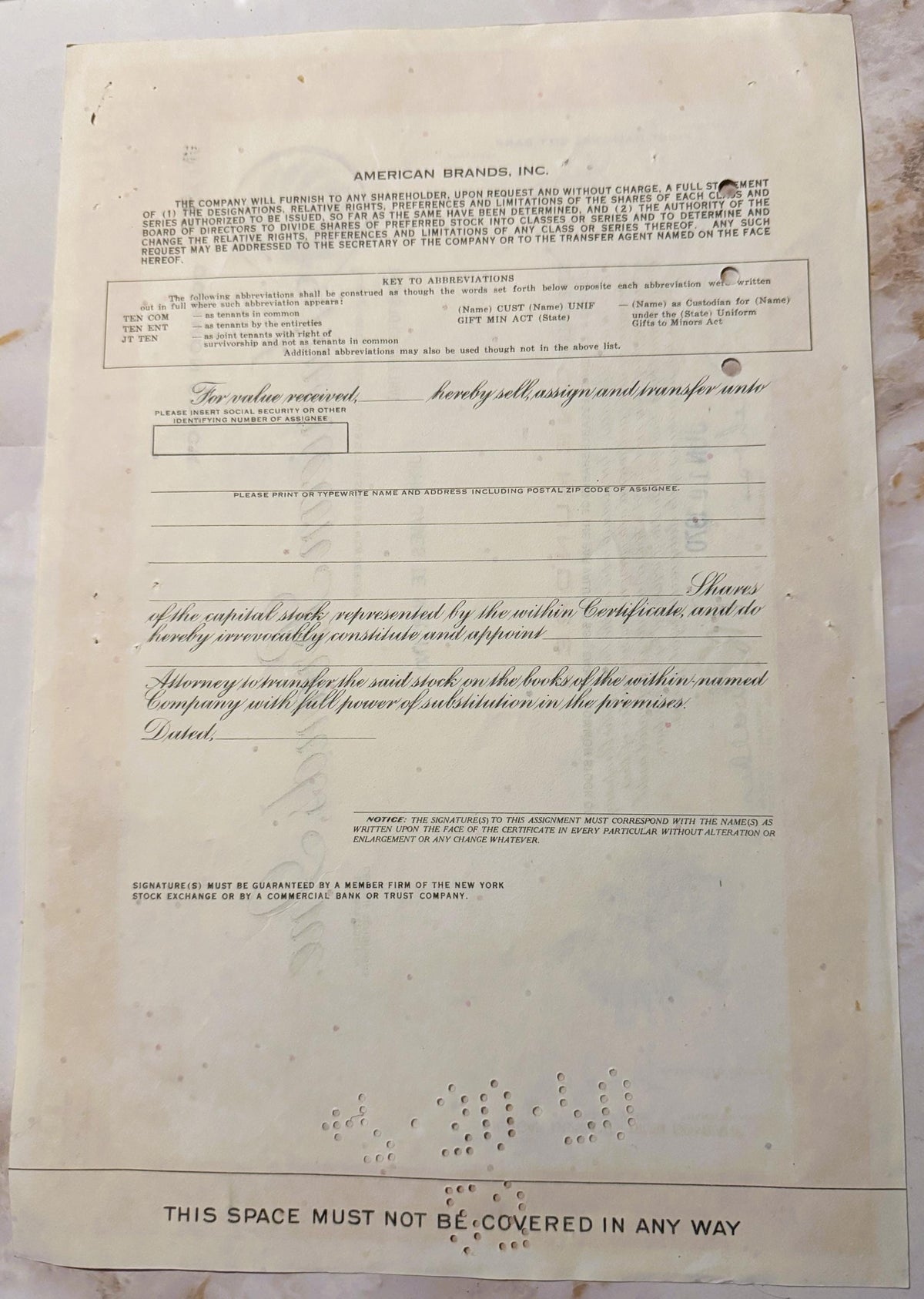
Vintage American Brands Stock Certificate 📜 Native American Chief Vignette, New Jersey Tobacco Americana
Vintage American Brands Stock Certificate 📜 Native American Chief Vignette, New Jersey Tobacco Americana
Ever held a piece of paper that watched an entire American industry reinvent itself? 🦅
There's a particular kind of magic in a stock certificate — it's not a photograph, not a newspaper clipping, but an actual working financial instrument, engraved and signed and dated, that once sat in a real person's lockbox or safe deposit drawer as proof of ownership in a real American company. This one carries something extra: a beautifully rendered engraving of a Native American chief in full feathered headdress, gazing off in profile, framed by the same intricate guilloche borderwork that security printers used to stop counterfeiters cold. It's the kind of image that shows up on currency and old bonds and precious little else — and it's sitting here on a piece of corporate Americana from a company that spent the better part of a century reinventing what "tobacco company" even meant.
This is a Common Stock certificate issued by American Brands, Inc., incorporated under the laws of the State of New Jersey, printed by the American Bank Note Company — the storied security printer responsible for generations of American currency, bonds, and stock certificates. Certificates in this series are dated June 1970, right at the dawn of the "American Brands" corporate identity, and measure a substantial 12" x 8", printed on the heavy, engraved stock typical of mid-century security documents. The color palette is striking and deliberate: a warm orange guilloche border wrapping a cream-white certificate field, with the chief's portrait rendered in fine black engraved linework in the lower corner, and the words "CERTIFICATE OF STOCK" overprinted diagonally across the body in that same bold orange ink. This is an issued certificate that was put to its intended use — registered, countersigned, and cancelled when it came back in.
🚬 From Duke's Trust to "American Brands" — The Company Behind the Certificate
The name printed across the top of this certificate — American Brands, Inc. — was brand new in 1970. As the Surgeon General's warnings about cigarettes gathered force through the 1960s, the company's leadership made a decision that would echo through corporate America for decades: they decided to get out from under the word "tobacco" itself. On July 1, 1969, the American Tobacco Company formally dropped "Tobacco" from its name and became American Brands, Inc. — a rebrand meant to signal a company no longer tethered to a single, increasingly scrutinized product. A certificate dated June 1970 is a snapshot from the very first year of that new identity, issued while the ink on the new corporate letterhead was practically still wet.
The roots go back much further. The American Tobacco Company was founded in 1890 by James Buchanan "Buck" Duke, built through the merger of rival tobacco manufacturers including Allen and Ginter, Goodwin & Company, and Kinney Brothers. It grew so dominant — controlling nearly 90% of the domestic cigarette market at its peak — that it became one of the defining targets of American antitrust law. The Supreme Court's 1911 ruling, applying the newly articulated "rule of reason," ordered the company broken into sixteen successor firms. Duke himself walked away from the tobacco business he'd built and turned his attention to hydroelectric power development in the Carolinas — the same fortune that would later found Duke University.
A reconstituted American Tobacco Company survived the breakup, and its Lucky Strike brand became one of the most recognized names in the industry — the blend perfected, by most accounts, under longtime executive Charles A. Penn. But by the mid-20th century, tobacco's grip on the American consumer was loosening, and the company began quietly using its cigarette cash flow to buy its way into other businesses entirely: Gallaher Limited (a major UK tobacco house), the James B. Beam Distilling Company, Sunshine Biscuits, Duffy-Mott, and a growing roster of office products makers. The 1969 name change to American Brands was the public declaration of a strategy that had already been underway for years — and 1970, the very year of this certificate, saw the acquisition of stapler maker Swingline, Inc., folding a beloved five-and-dime desk staple into the same portfolio as pipe tobacco and bourbon.
The diversification only accelerated from there — golf equipment maker Acushnet joined the fold in 1976 — until, in 1994, American Brands sold the original American Tobacco Company outright to British American Tobacco for a reported billion dollars, formally severing the tobacco lineage that had defined the company for over a century. Three years later, in 1997, the company renamed itself again, becoming Fortune Brands, Inc. — and in 2011 that entity split into two separate public companies, eventually sending its spirits business into what's now known as Beam Inc., acquired by Japan's Suntory in 2014. The corporate name on this certificate — American Brands, Inc. — has been renamed, sold, and split so many times since 1970 that it exists today only in paper like this.
🖨️ The Engraver's Craft: American Bank Note Company
The chief's portrait, the fine-line guilloche border, the crisp lettering — all of it is the handiwork of the American Bank Note Company, one of the most important security printers in United States history. The firm traces its lineage to 1795, to an engraving house founded by Robert Scot, the first official engraver of the U.S. Mint. Through a cascade of 19th-century mergers — an 1858 alliance of seven competing security printers, an 1879 merger absorbing the National Bank Note Company and Continental Bank Note Company, and a 1911 merger with the United Bank Note Company — American Bank Note grew into the largest producer of financial paper on earth, engraving everything from currency and postage stamps to the stock and bond certificates that documented American industry itself.
Its New York headquarters and printing plant, both completed in 1908, still stand as designated New York City landmarks — a testament to how central this company was to the machinery of American finance. The intaglio engraving technique on display here — raised, richly detailed linework impossible to photocopy or forge convincingly — was the whole point: a stock certificate had to look like money, because in a very real sense, it was.
🪶 The Chief in the Headdress
Engraved vignettes of Native American chiefs were a favorite motif of American security printers throughout the late 19th and 20th centuries, appearing on currency, bonds, and stock certificates as a kind of shorthand for American identity itself — dignity, gravity, the frontier spirit repackaged as financial trust. This particular engraving renders the sitter with real care: the deep furrows of the face, the individual feathers of the war bonnet trailing down past the shoulder, each rendered in the fine cross-hatched linework that only an engraver trained in bank-note work could produce. It's a striking piece of period American iconography, sitting quietly in the corner of a document that otherwise concerns itself entirely with shares, par value, and corporate seals.
🏦 The Paper Trail: Registrar and Transfer Agent
Every stock certificate of this era carried its own built-in chain of custody, and this one names two heavyweight New York financial institutions: First National City Bank as registrar, and Morgan Guaranty Trust Company of New York as transfer agent — the institutions, predecessors to names still recognizable in banking today, that stood behind every transfer of ownership and every countersignature that made a certificate like this legally valid. The par value printed on the certificate — $6.25 per share — is itself a small artifact of old-school corporate finance, back when companies set a nominal per-share value on the books quite apart from whatever the stock actually traded for on the floor.
📈 Why It Still Resonates Today
Paper stock certificates like this one are a vanishing category of Americana. The very first stock certificate is said to have been issued by the Dutch East India Company in 1606, and the tradition ran essentially unbroken for over four centuries — until major American corporations began phasing out paper certificates altogether in favor of electronic book-entry ownership. The Walt Disney Company's 2013 issuance is often cited as one of the last paper stock certificates from a major American corporation, closing a chapter that had run since the 1600s. A certificate like this one — engraved, signed, dated, and issued into a real shareholder's transaction — is a physical relic of that entire era: the moment when owning a piece of a company meant holding an actual piece of engraved paper, not a line item in a brokerage account.
🖼️ Display Ideas
- 🖋️ Framed alone under glass in a home office or den, letting the orange guilloche border and the chief's portrait carry the whole wall
- 📚 Paired with other tobacco-era or Americana ephemera in a curated "Wall Street history" grouping
- 🎩 Matted alongside vintage cigarette tins or advertising art for a themed collector's corner
- 🏛️ Displayed near business or finance books as a conversation-starting artifact of corporate history
- 🎁 Given as a gift to a collector, history buff, or anyone fascinated by the American Bank Note Company's engraving craft
- 🖼️ Rotated seasonally with other historical stock and bond certificates for an evolving "history of American industry" display
🎁 Who Collects These
Scripophily — the collecting of antique stock and bond certificates — draws a particular crowd: history buffs who want a tangible piece of a story like American Tobacco's antitrust breakup and reinvention, engraving enthusiasts drawn to the American Bank Note Company's craftsmanship, Americana collectors chasing the Native American iconography so common on old security paper, and everyday gift-givers looking for something with real substance behind it — a birthday, retirement, or Wall Street enthusiast gift that tells an actual story rather than sitting blank on a shelf. It's also a natural pickup for anyone who enjoys the five-and-dime, midway-era feel of vintage American advertising and finance, where even a stock certificate was designed to be looked at, not just filed away.
❓ FAQ
Is this an authentic vintage stock certificate, or a reproduction?
This is a genuine, period-printed certificate from American Brands, Inc., engraved by the American Bank Note Company — not a modern reproduction.
What should I expect on a certificate like this?
Expect an issued document: ink entries, transfer-agent and registrar signatures and stamps, and cancellation punches, with the details varying from one example to the next.
Is this certificate still valid as actual stock?
No — American Brands, Inc. went through multiple corporate name changes and splits over the following decades (eventually becoming Fortune Brands and later separate companies), and paper certificates of this kind were long ago superseded by electronic share registration. This piece is collected today as a historical artifact, not a live financial instrument.
Who is the Native American chief pictured on the certificate?
The engraving is a stylized period vignette in the tradition of American Bank Note Company security printing, rather than a portrait of a specific named individual — this kind of imagery was a common motif across American currency and financial paper of the era.
What is the certificate printed on?
It's printed on heavy engraved paper stock, using the intaglio printing technique and guilloche border patterns typical of American Bank Note Company security documents — the same class of engraving used on historical currency and bonds.
Why did the company change its name from American Tobacco to American Brands?
As health concerns around cigarettes intensified through the 1960s, the company diversified into other consumer businesses and, in 1969, dropped "Tobacco" from its corporate name to reflect that broader portfolio — this certificate dates to the very first year of that new identity.
Does the size make it suitable for framing?
At 12" x 8", it's a substantial document-sized piece that displays well framed on its own or matted alongside other historical ephemera.
These are issued instruments rather than blanks. Certificates of this type were filled in for a holder in ink, countersigned by the transfer agent and registered by the registrar, then punch- or cut-cancelled when they were redeemed and retired. Expect financial writings, markings, stamps, hole punches and staple holes as part of the life of the instrument: endorsements and signatures, transfer-agent and registrar stamps, revenue or documentary tax stamps, cancellation punches, staple holes from being bound into a transfer book, pencil ledger notations. That is the paper trail of a security that actually did its job, and it is what separates a document that lived from a blank that never did. No two are alike: holder details, serial numbers, dates, signatures, stamps and punch patterns vary from example to example, so the photographs show the type rather than the exact sheet that ships.
🔎 More From The Vintage & Antique Gifts Archive
Couldn't load pickup availability
Low stock: 9 left
View full details