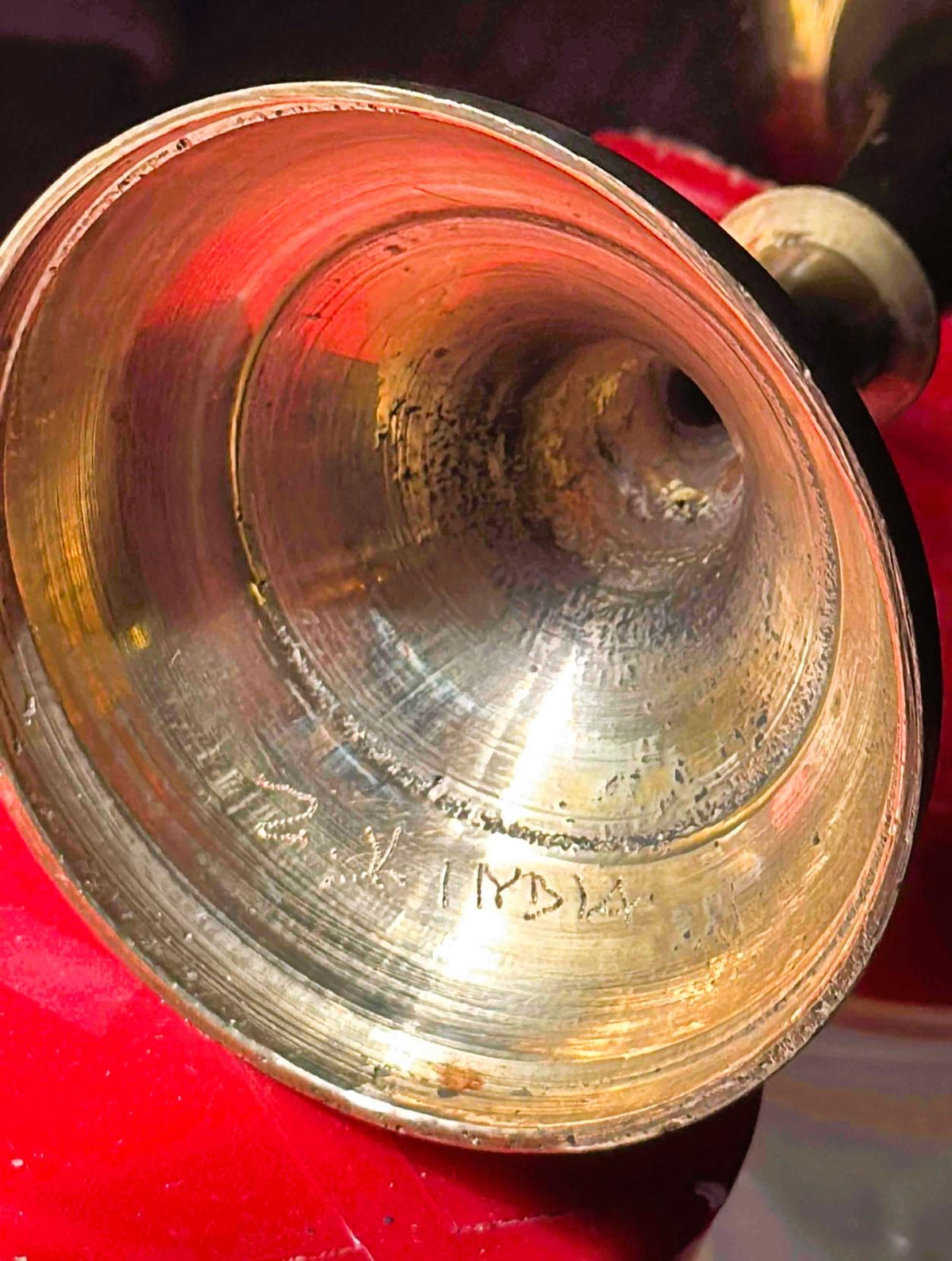
Vintage Etched Brass Goblet Chalice 🏺 Indian Bright-Cut Engraving INDIA Scratch Mark to Base
Vintage Etched Brass Goblet Chalice 🏺 Indian Bright-Cut Engraving INDIA Scratch Mark to Base
🏺 A Brass Goblet, Told Exactly as It Is
This is a vintage etched brass goblet in the classic Indian bright-cut export style -- a tall, formal cup-and-stem form, entirely hand engraved, with an honest, unpolished patina and one small, telling detail scratched into the underside of its base. Every claim in this listing is read directly from the piece itself, nothing more and nothing less: a dense, hand-cut engraved pattern across the cup, and a crude scratched word on the foot that reads plainly as INDIA, lining up exactly with the engraving style covering the rest of the piece.
🔍 What You're Actually Looking At
The goblet stands in the classic chalice silhouette: a flared, bell-shaped cup atop a slender waisted stem, a decorative central knop partway down, and a wide, stable round foot. It is worked entirely in brass, and the cup is covered edge to edge in a dense, all-over bright-cut engraving -- a pattern of overlapping fan and shell shapes, each built from tightly spaced radiating lines cut directly into the metal so that the facets catch the light at different angles as the piece turns. This bright-cut technique, cutting a faceted line into the metal rather than simply scratching a flat scribed line, is the hallmark of a specific and well-documented decorative tradition: Indian export brassware, produced for generations by skilled metalworkers for both the domestic and the Western trade. The foot of the goblet carries its own engraved band echoing the same fan motif, tying the whole piece together top to bottom.
Turn the goblet over and look at the underside of the base, and you will find the detail that grounds this entire listing: a crude, hand-scratched inscription, clearly added after the piece was cast and finished rather than engraved as part of its original decorative program. Read plainly, it says INDIA. There is no other inscription anywhere on this piece in any of its photographs. What is there is consistent, legible, and points to exactly the country its engraving style already tells you: India.
📝 Reading the Base Mark
That scratched word on the underside of the base is worth a closer look. It is crude and hand-done -- uneven letterforms, clearly scratched rather than engraved with the same skilled tool used on the cup's decoration -- which tells us it was added separately from the piece's original manufacture, likely by someone further along in its ownership or trade history noting where it came from. Marks like this are common on vintage export brass: pieces moved through dealers, importers, and collectors over the decades, and a simple scratched country name was often added along the way as a plain, practical note of origin. It sits in honest contrast to the fine, deliberate bright-cut work covering the rest of the goblet, and it is the one piece of direct textual evidence this goblet carries about where it was made.
🎨 The Craft of Indian Bright-Cut Brass
Bright-cut engraving is a specific hand technique, distinct from simple flat engraving: the craftsman angles a sharp graver to slice a faceted furrow into the brass rather than a flat scratched line, so that each stroke reflects light differently depending on the angle it was cut at. Built up in overlapping rows, as it is here, the technique creates a shimmering, almost textile-like surface -- the fan and shell motifs on this goblet catch and scatter light constantly as it is turned in the hand or under a lamp. This style of dense, all-over engraved brassware was produced across India for generations, supplying both the domestic market and, especially from the later nineteenth century onward, a strong export trade to Western buyers who prized exactly this kind of intricate, entirely hand-worked metalwork. Brass itself -- durable, warm-toned, and workable -- has been the material of choice for devotional vessels, formal drinkware, and decorative ware across South Asia for centuries, and a chalice-form goblet like this one sits comfortably within that long, continuous tradition of skilled brass craftsmanship.
🌍 Moradabad and India's Brass Export Trade
Documented, general context worth knowing, apart from anything specific to this one goblet: India's brass trade has long been centered on cities like Moradabad, in Uttar Pradesh, historically nicknamed India's "brass city" for the sheer scale and concentration of brass workshops operating there since at least the colonial era. Generations of craftsmen in centers like this one built a substantial export trade supplying engraved, embossed, and cast brassware to markets across the world, alongside strong domestic demand. Bright-cut engraving of the kind on this goblet was one of the signature decorative techniques to come out of that broader Indian brassworking tradition -- prized specifically because it was entirely hand done, piece by piece, rather than stamped or cast in a mold. We say this as general, documented trade history, not as a specific claim about where this exact goblet was made; the goblet's own scratched INDIA mark and its engraving style are the evidence we actually have for this piece. Workshops in centers like this typically employed skilled engravers who trained for years to master the bright-cut technique, passing the craft down through families and apprenticeships rather than through any formal industrial process.
🕯️ The Chalice Form, Broadly
The tall, stemmed cup shape itself -- flared bowl, waisted stem, wide stable foot -- is one of the oldest and most widespread drinking-vessel forms in the world, appearing across countless cultures wherever metalworkers wanted a cup raised above the table for a formal setting. That broad, general history is worth knowing simply because it explains why the shape feels so instantly recognizable: it is a functional design solved independently, again and again, across centuries and continents. This particular goblet takes that familiar universal shape and dresses it entirely in Indian bright-cut decoration, which is what actually identifies it, rather than the shape alone. It is the engraving, not the silhouette, that tells you the real story of where and how this piece was made.
🔍 Condition, Told Plainly
This is a genuine vintage piece, and it shows the honest, unpolished patina of age throughout -- a warm, deepened brass tone rather than a bright, buffed shine, consistent with a piece that has been kept and handled rather than recently refinished. The engraving remains crisp and fully legible across the cup and foot. We have not measured this piece with a tape, so no dimensions are given here; what we can tell you honestly is that it reads as a substantial, well-proportioned goblet in the hand -- a genuine tabletop presence rather than a miniature novelty, comfortably scaled the way a formal drinking chalice should be.
🖼️ Display Ideas
- 🏺 Set it on a sideboard or bar cart as a single striking accent piece, letting the engraving catch ambient light.
- 🕯️ Pair it with other brass decorative objects -- trays, candlesticks, bowls -- for a warm, layered metalwork vignette.
- 📚 Group it with other Indian export brassware or South Asian decorative pieces for a themed collection shelf.
- 🎁 Give it as a housewarming or milestone gift to anyone who loves genuine hand-engraved metalwork.
- 🕯️ Use it as a candle holder or simply as sculptural tabletop decor -- its form reads beautifully even unlit and empty.
🎁 Who Collects These
- 🏺 Brassware and metalware collectors who seek out genuine hand-engraved export pieces.
- 🌍 Collectors of Indian and South Asian decorative arts.
- 🏡 Home decorators drawn to warm, textured brass accents with real handwork behind them.
- 🕯️ Barware and tabletop-display enthusiasts looking for a genuinely old, one-of-a-kind piece.
- 🎁 Gift-givers seeking something with real craftsmanship and an honest story.
❓ Honest Answers
Is this a devotional or religious object?
We do not describe it as one. It is a decorative brass goblet in the chalice form, engraved in the Indian bright-cut export style. There is no documented religious use or inscription on this piece, and none is claimed.
Does the base marking date the piece?
No -- it is a scratched country-of-origin note, not a date. No dated maker's mark of any kind appears anywhere on this goblet.
How old is this piece?
No dated maker's mark exists on the goblet, so an exact year cannot be given. The engraving style is consistent with the long-running tradition of Indian export brassware production.
How large is the goblet?
We have not taken a tape measure to this piece, so we will not give a false precision here. In the hand, it reads as a substantial, well-proportioned chalice-form goblet -- please use the photographs, including any shown beside a common object, to judge scale for yourself.
Is the engraving cast or hand cut?
It is hand engraved, using the bright-cut technique -- a faceted line cut directly into the brass with a graver, not a cast-in pattern.
A genuine vintage brass goblet, its craftsmanship and its country of origin both grounded in exactly what the piece itself shows -- careful bright-cut Indian brasswork and a small scratched word on the base that tells its own quiet story.
Couldn't load pickup availability
Low stock: 1 left
View full details